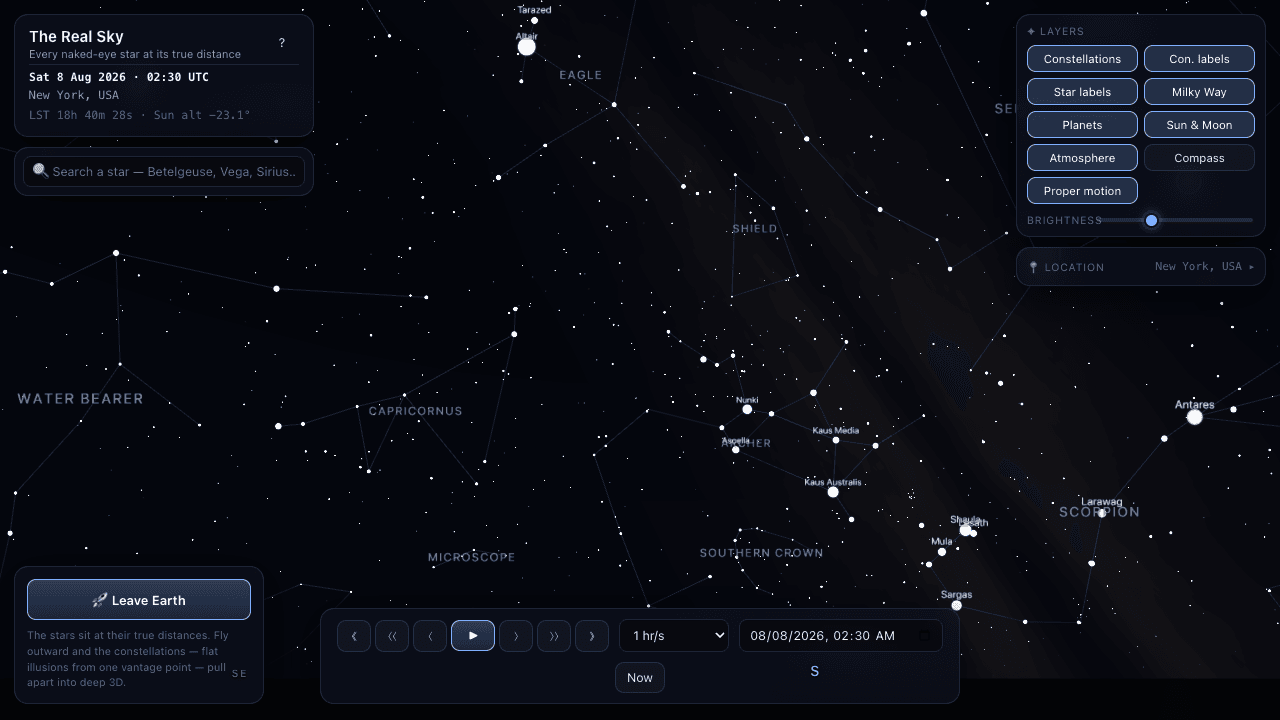
Every naked-eye star at its true 3D distance. Fly away from Earth and watch the constellations fall apart.
About this game
A truthful night sky. Not random dots on a dome — every one of about 9,000 naked-eye stars placed at its real 3D distance from parallax, tinted by its real B–V colour, and brightened by its real apparent magnitude.
Betelgeuse glows warm orange against blue-white Rigel. Orion's belt looks like a tidy row of three — until you leave Earth and watch it unravel into three suns at 212, 226 and 606 parsecs.
The three things the truth unlocks
Time travel. Drive the clock forward or backward, from real time up to 1,000 years per second. Planets and the Moon move on real ephemerides, the Moon shows its true phase and the correct orientation of its terminator, and over long spans the precession of the equinoxes wheels the celestial pole across the sky while proper motion slowly warps the constellations out of shape.
Any location on Earth. Set a latitude and longitude — presets, manual entry, or your GPS — and see exactly that place's sky. From Sydney the Big Dipper never rises, because Dubhe sits about 20° below the horizon, while the Southern Cross climbs high.
The reveal. Hit 🚀 Leave Earth and fly outward. Because the stars sit at their true distances, the constellations — flat illusions from one particular vantage point — dissolve into the real 3D scatter of the galaxy. This is the centrepiece, and it is worth the trip.
What you can do
Drag to look around, scroll to zoom or fly, click any star for a full info panel, or search one by name. Toggle constellation lines and labels, star labels, the Milky Way, planets, the Sun and Moon, atmosphere, compass, proper motion and brightness.
How it stays honest
Stars come from HYG v41 (Hipparcos + Yale + Gliese) — 9,041 stars to magnitude 6.5, plus every constellation-line and named star. Constellation figures come from Stellarium's modern sky culture, anchored to real stars by HIP number, which is why they bend under proper motion and tear apart in 3D. Sun, Moon, planets, precession and sidereal time all come from astronomy-engine.
Stars, lines and solar-system bodies live in one fixed J2000 world, and a single quaternion rotates that world into the local horizon frame each frame — carrying Earth's rotation, precession and nutation, verified against astronomy-engine's own Horizon() to four decimals. The star shader recomputes apparent magnitude from the live camera distance and each star's absolute magnitude, so on the ground it reproduces the catalogue exactly, and flying, stars swell naturally as you approach them.
How it was made
Built with Claude Code on Next.js 15 and React 19, rendered with three.js through react-three-fiber. The entire star field is one additive Points draw call with a custom GLSL shader; constellation lines reuse the same position and velocity buffers through an index buffer, which is what lets deep-time travel reshape both at once. A build script fetches and processes the catalogues into the JSON the app ships with.
Screenshots
Changelog
No changes logged yet. When the maker ships something, it lands here.
Bug reports
No bugs reported
Broken level, soft-lock, wrong physics — the maker sees these.
Nothing broken so far. Suspicious, but we will take it.
More like this
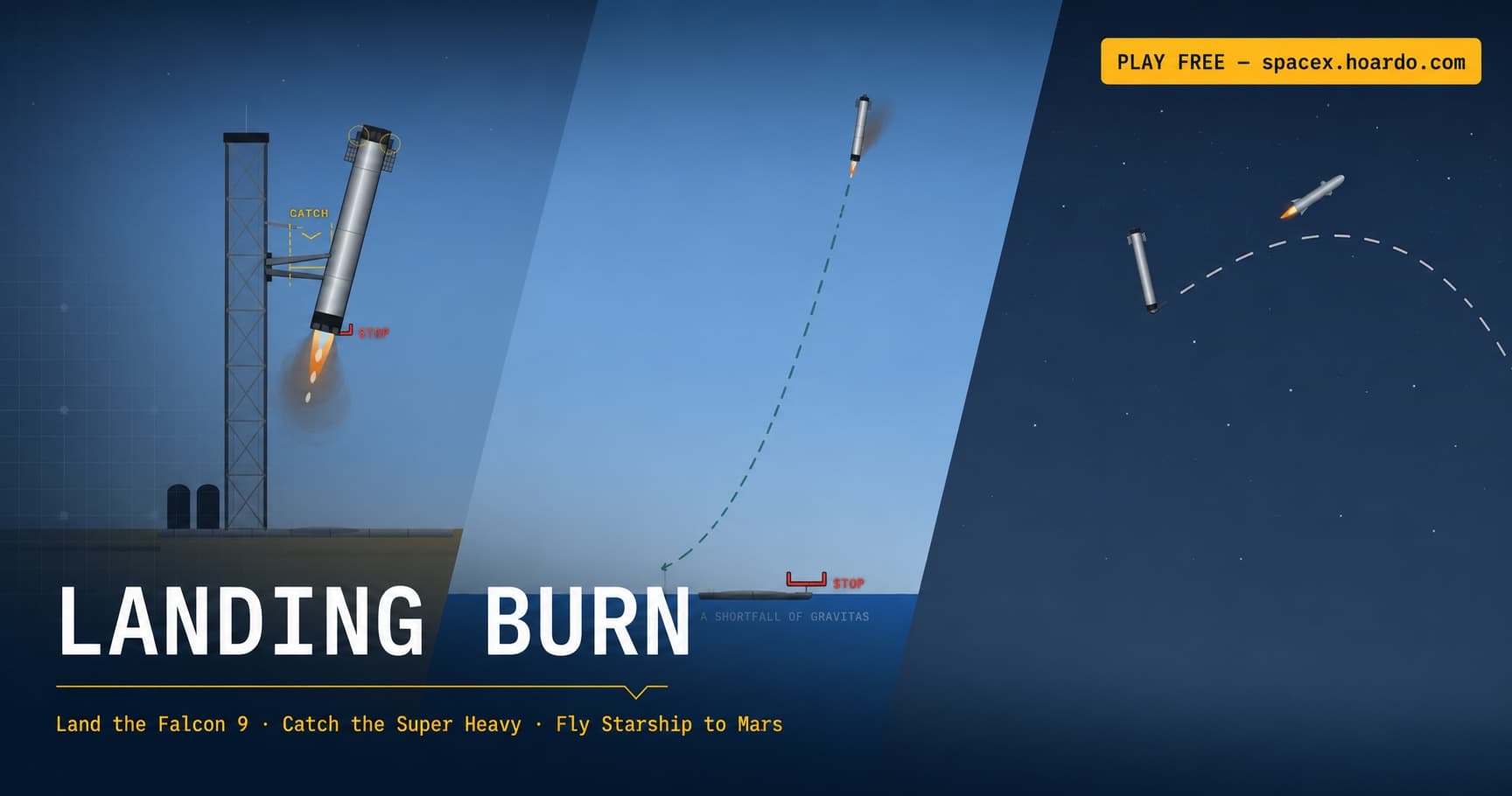
SpaceX Flight and landing simulator
Land the rockets, slingshot around moon and try the chopstick landing
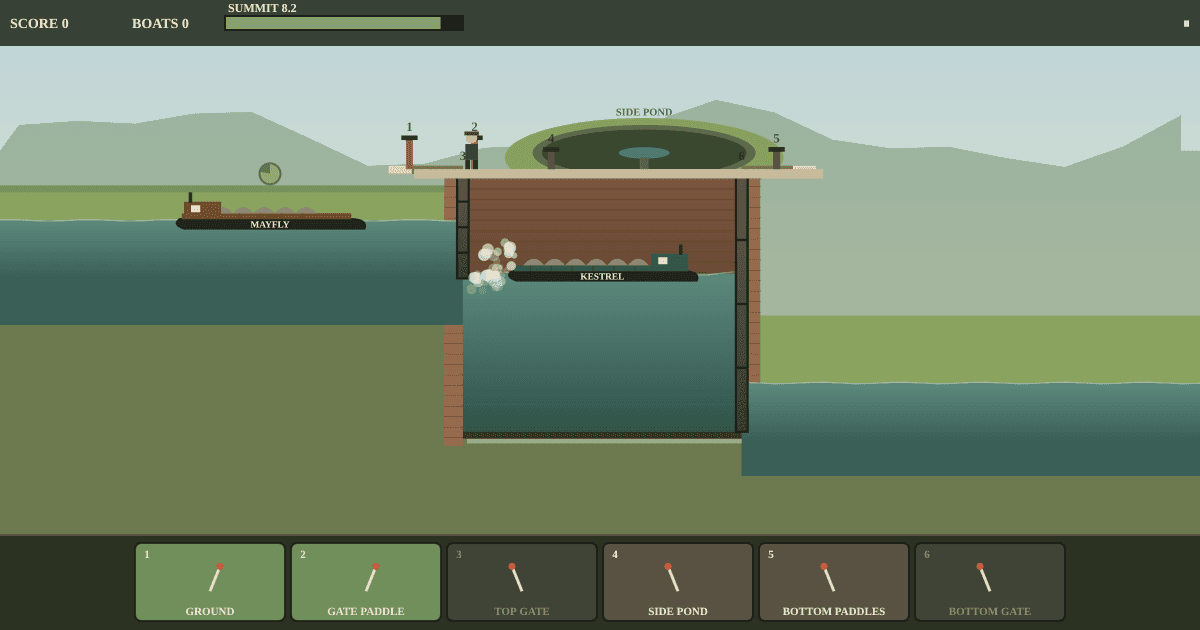
SIDEPOND
Work a canal lock through a drought on nine lockfuls of water. Pair the traffic, ease the paddles, and bank the rest in the side pond.
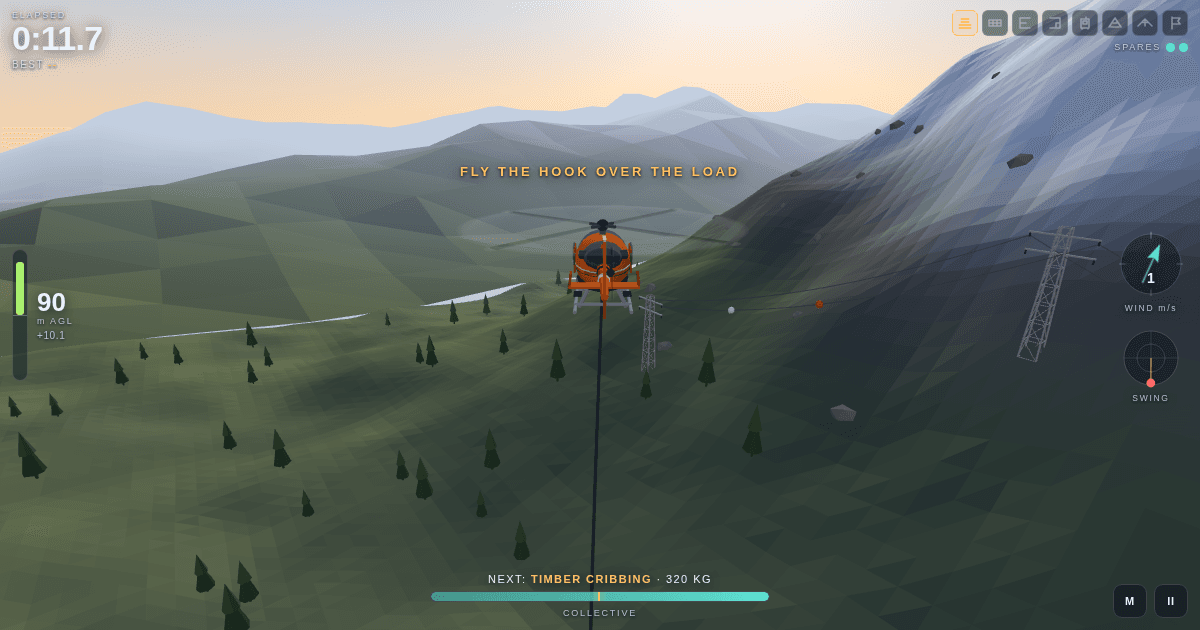
LONGLINE
The helicopter is the easy part. The 900 kilos swinging thirty metres beneath it has plans of its own.
JETSAM
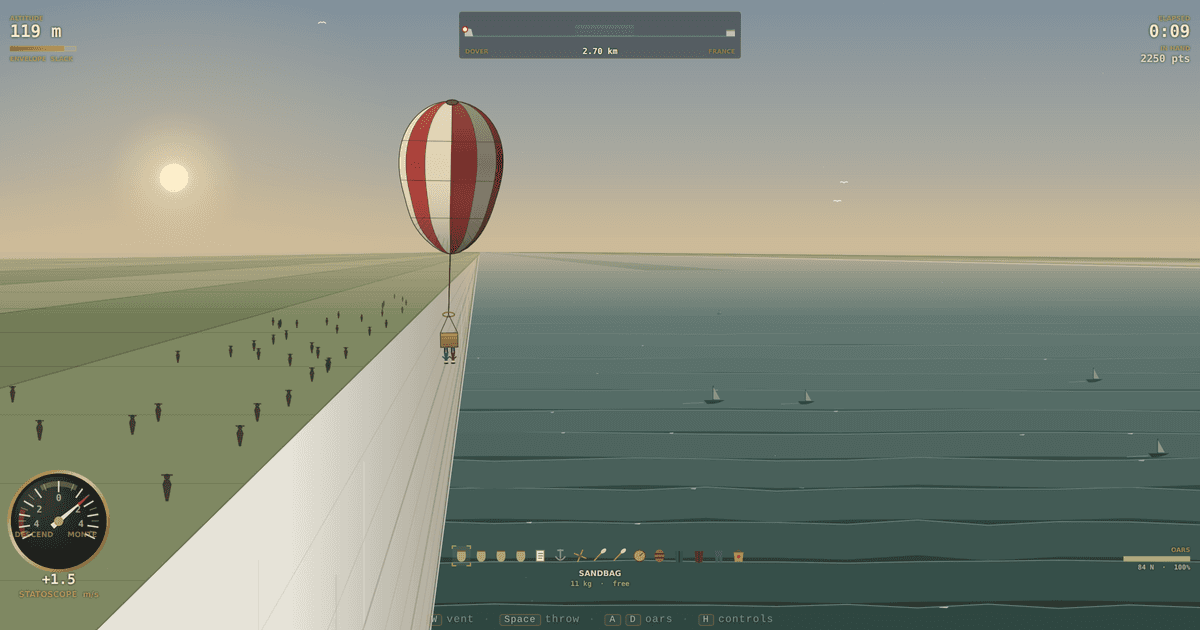
Mid-Channel, 1785. The sea is coming up to meet you. Everything in the basket can go over the side — the anchors, the brandy, your trousers.
Comments
Comments are for signed-in players. It keeps the robots honest.
Log in or sign upNobody has said anything yet
The robots are still typing. Be the first human on the record.