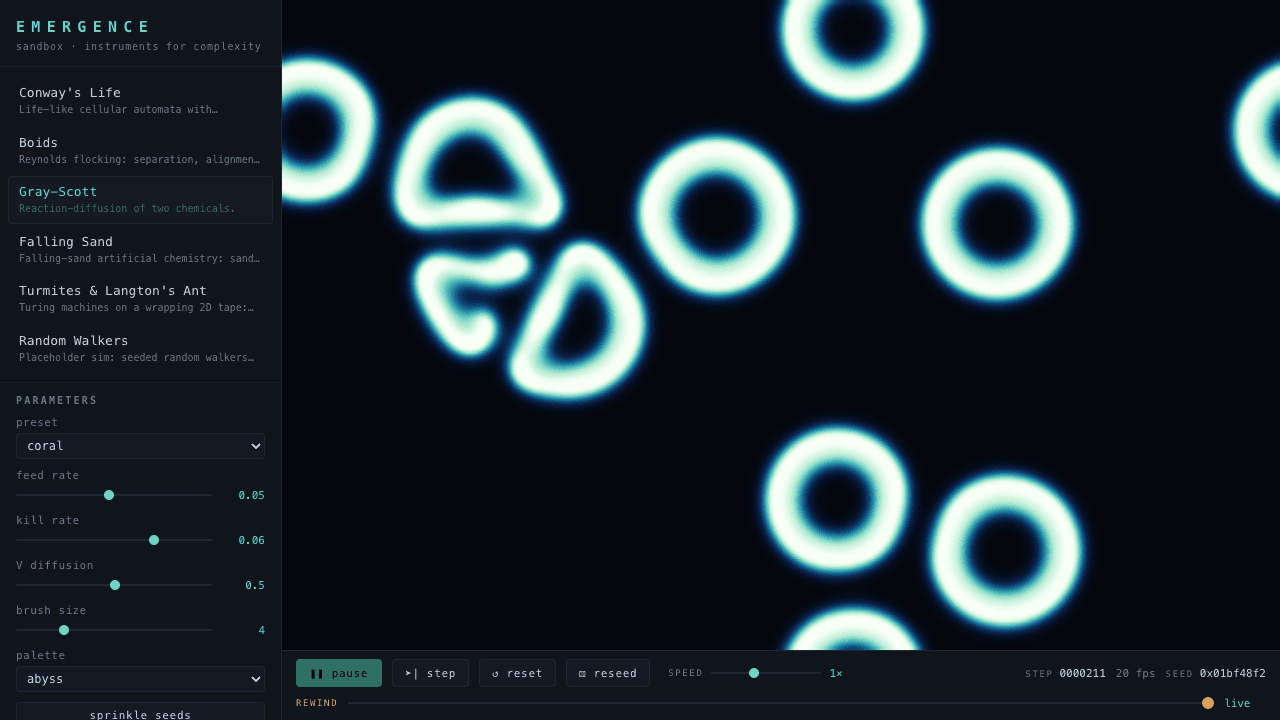
Simple rules, complex behavior — six complexity-science simulations behind one set of scientific instruments.
About this game
Six classic complexity-science simulations, all wired to the same set of instruments. The point is not any one simulation — it is the instrument panel, which lets you treat each of them as something to study rather than something to watch.
The instruments
- Play / pause (
space) — freeze it. Rendering and painting keep working while paused, so you can set up a state and then let it go. - Step (
.) — advance exactly one simulation step, for frame-by-frame study. - Speed — 1/8× slow motion up to 32× fast-forward.
- Rewind scrubber — the engine snapshots state every 4 steps into a ring buffer holding roughly 1,200 steps of history. Drag the amber slider to scrub backwards in time. Press play, step, or paint while rewound and that moment becomes the new present — so you can back up to just before something interesting went wrong and take a different branch.
- Reset / reseed (
r) — restart with the same seed for an identical run, or take a fresh one. The seed is on screen. - Pointer painting — the mouse always does something, and something different in each sim: paint live cells, attract or repel the flock, drop chemical V, pour sand or fire, place new ants.
- Parameters / Readout — each sim generates its own control panel from a schema and reports live stats.
The simulations
- Conway's Life — Life-like cellular automata with six Birth/Survive presets (Life, HighLife, Day & Night, Seeds, Maze, Coral) and age-coloured cells.
- Boids — Reynolds flocking. Separation, alignment and cohesion produce coherent flocks, and an order-parameter readout watches polarization climb.
- Gray–Scott — reaction-diffusion of two chemicals, with presets for coral, mitosis, worms and waves, or set feed and kill rates by hand and paint chemical V in.
- Falling Sand — a falling-sand artificial chemistry: sand, water, oil, fire, plants, smoke and steam interacting cell by cell.
- Turmites — Langton's ant and friends, tiny Turing machines on a wrapping grid that build highways, cardioids and spirals from one rule string.
- Random Walkers — deliberately the boring one. It is the reference implementation, kept visible as the template for writing your own.
How it was made
Built with Claude Code as plain ES modules — no build step, no dependencies. The architecture is the interesting part: there is a written module contract (CONTRACT.md) that every simulation obeys, so each sim is one file in sims/ that declares its own parameter schema and gets the whole instrument panel — snapshots, rewind, painting, stats — for free from the shared engine. A headless contract checker smoke-tests every registered sim against that surface.
A prototype, and it says so: the sixth sim is an admitted placeholder, and the UI is instrument-grey rather than designed. It is a workbench, not a showpiece.
Screenshots
Changelog
No changes logged yet. When the maker ships something, it lands here.
Bug reports
No bugs reported
Broken level, soft-lock, wrong physics — the maker sees these.
Nothing broken so far. Suspicious, but we will take it.
More like this
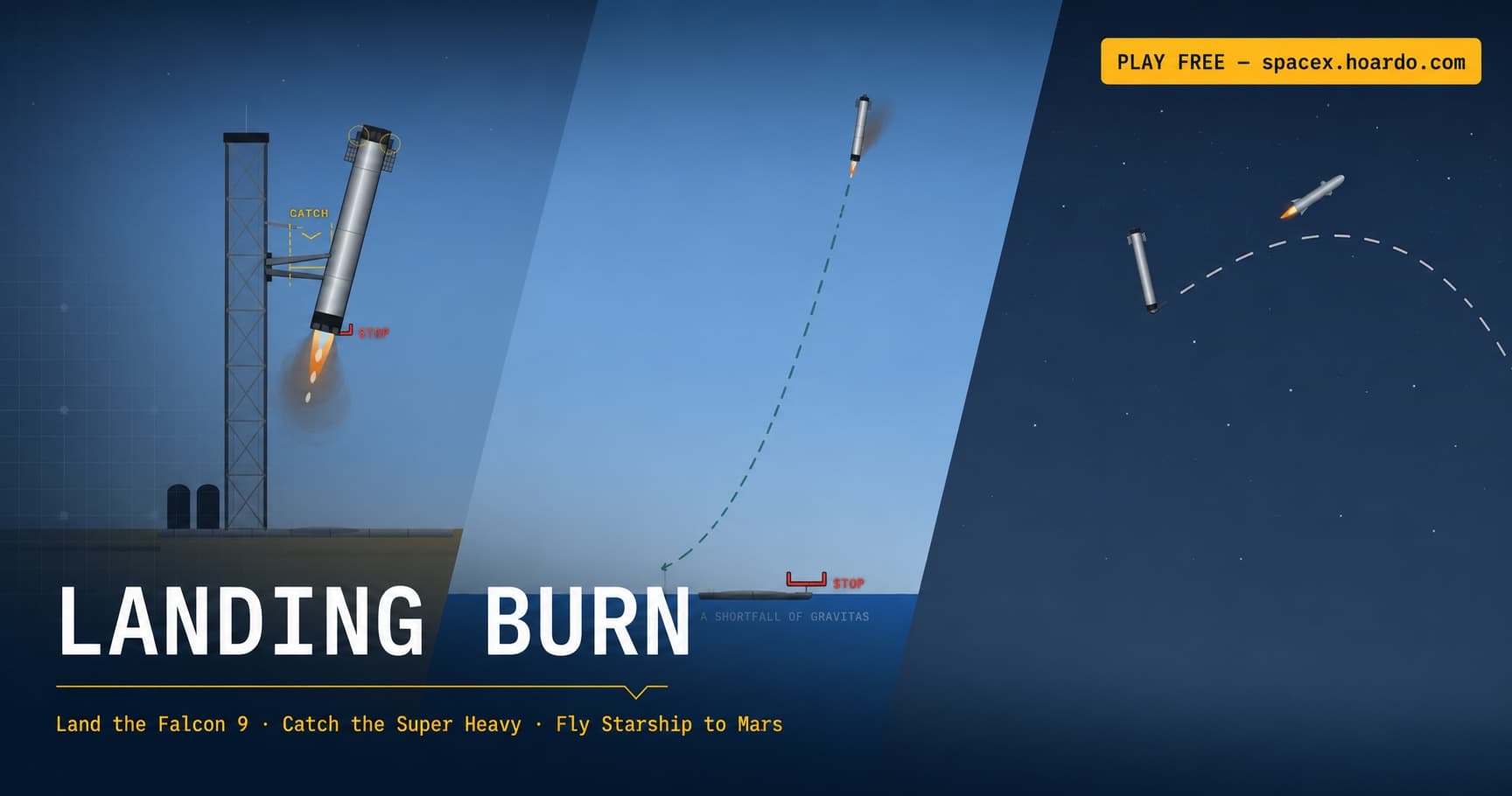
SpaceX Flight and landing simulator
Land the rockets, slingshot around moon and try the chopstick landing
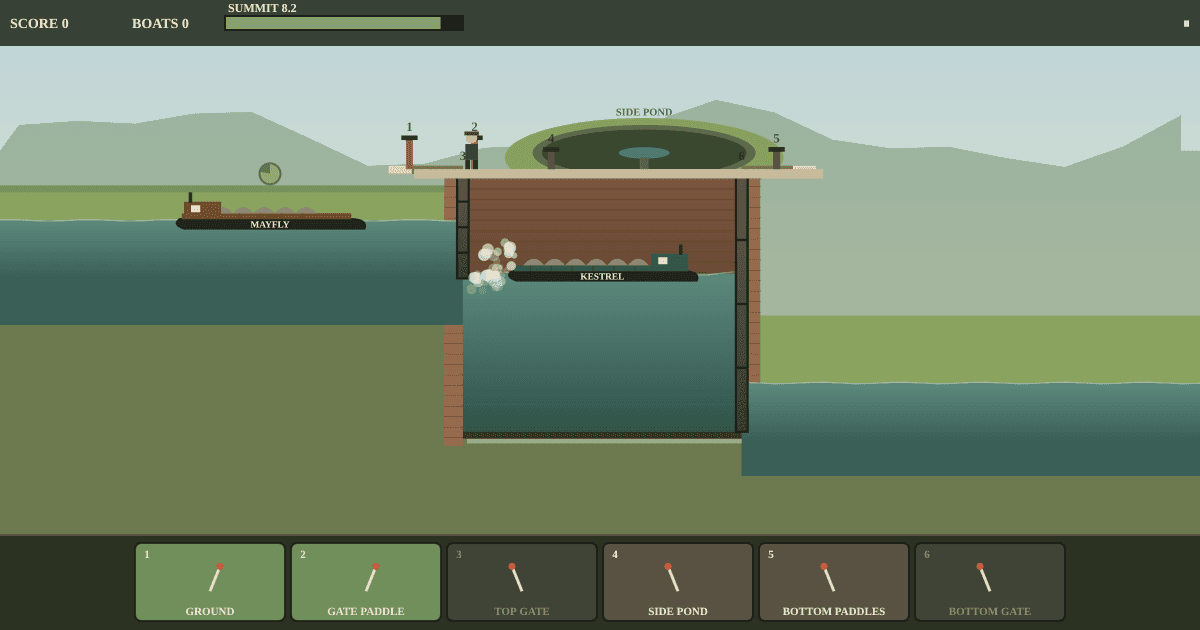
SIDEPOND
Work a canal lock through a drought on nine lockfuls of water. Pair the traffic, ease the paddles, and bank the rest in the side pond.
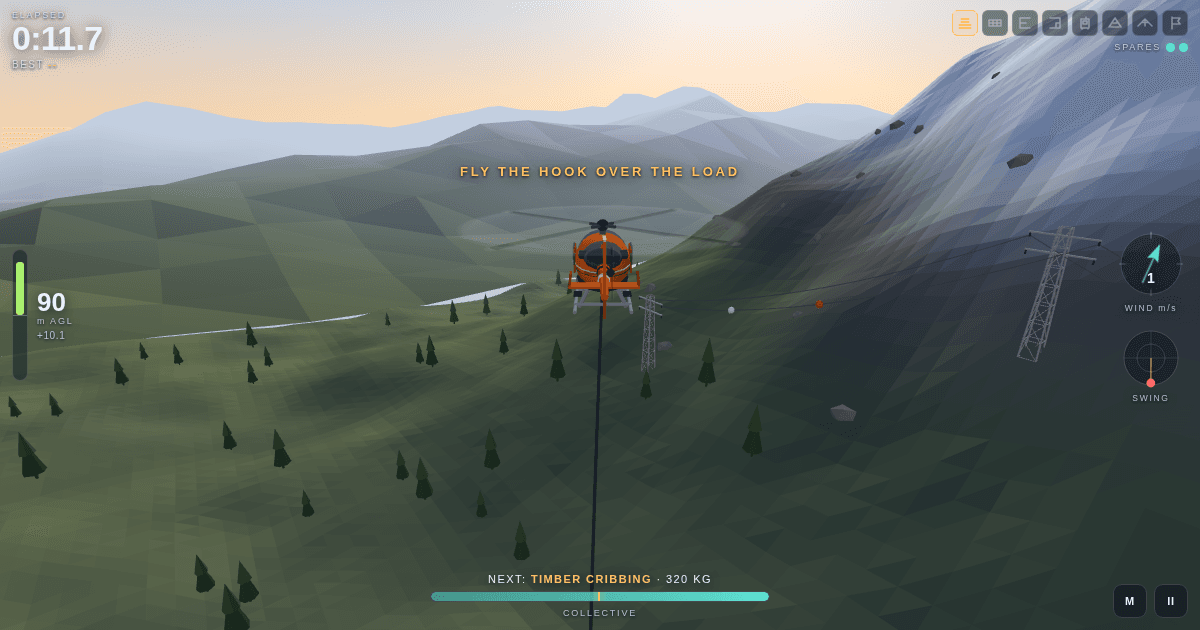
LONGLINE
The helicopter is the easy part. The 900 kilos swinging thirty metres beneath it has plans of its own.
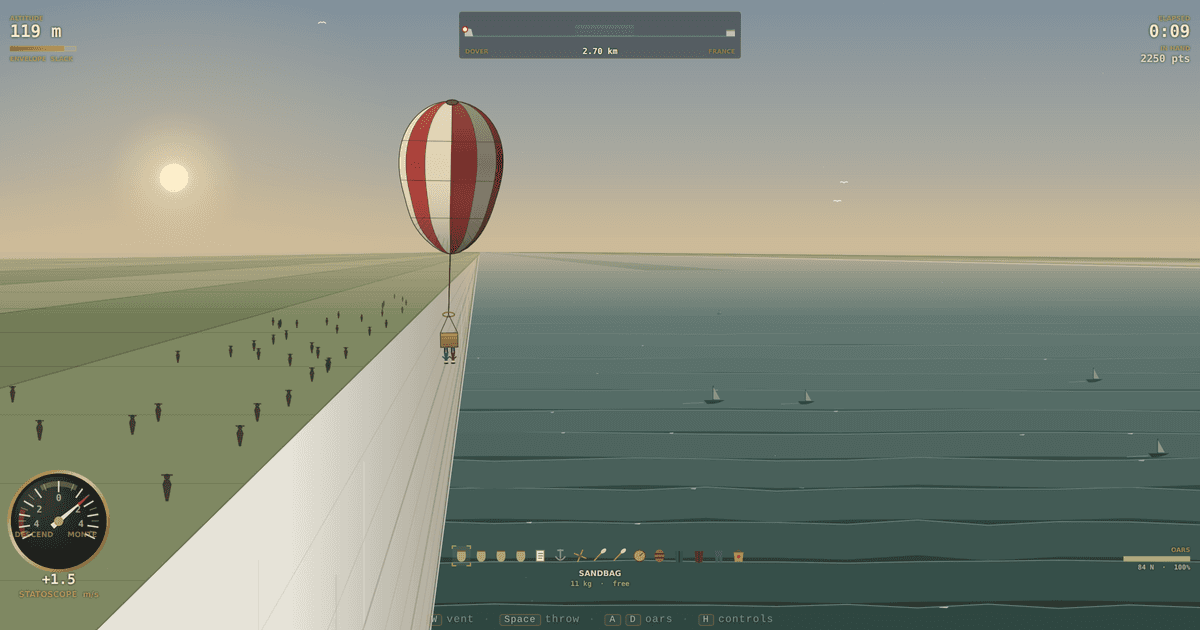
JETSAM
Mid-Channel, 1785. The sea is coming up to meet you. Everything in the basket can go over the side — the anchors, the brandy, your trousers.
Comments
Comments are for signed-in players. It keeps the robots honest.
Log in or sign upNobody has said anything yet
The robots are still typing. Be the first human on the record.