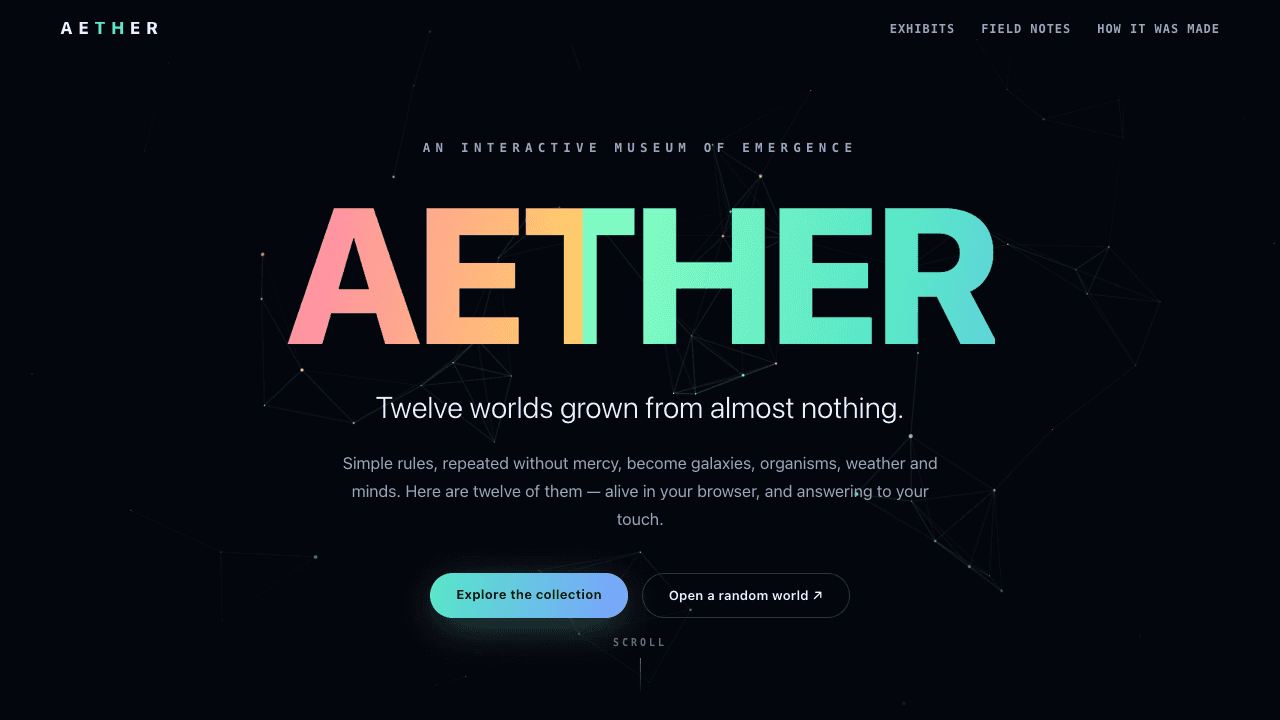
A cabinet of living systems. Twelve worlds grown from almost nothing, all answering to your touch.
About this game
AETHER is an interactive museum of emergence: twelve self-contained simulations, each a different way that enormous complexity pours out of a rule simple enough to explain to a child.
No one is in charge in any of these worlds. A particle leans toward some colours and away from others. A bird matches its neighbours. A chemical eats another chemical. Nothing knows what it is building. And yet they build galaxies, organisms, weather and minds.
The collection
| # | Exhibit | The rule | |---|---------|----------| | 01 | Particle Life | an asymmetric table of attractions between colours | | 02 | Slime Mold | sense ahead · turn toward scent · deposit | | 03 | Murmuration | separate · align · cohere | | 04 | Reaction–Diffusion | two chemicals, one feeds and one kills | | 05 | Cymatics | sand flees a vibrating plate to its silent lines | | 06 | Dendrites | random walk until you touch, then freeze | | 07 | Flow Field | follow the curl of a breathing noise field | | 08 | Fluid | real-time Navier–Stokes, stirred by hand | | 09 | Gravity | softened Newtonian N-body, Barnes–Hut | | 10 | Strange Attractors | iterate a nonlinear map forever | | 11 | Fractal Explorer | z → z² + c | | 12 | Smooth Life | Conway's Life poured off its grid |
Every exhibit is full-screen and interactive — the mouse always does something — and carries five to eight controls plus a reseed. Change the rule and a different universe falls out. Each one also explains itself in a panel written in plain language, so you can find out what you are looking at without leaving it.
The front door is the atlas: a landing page with a living constellation hero, a gallery of the twelve, field notes on what emergence actually is, and an "open a random world" button for when you do not want to choose.
How it was made
In a single night, by a fleet of agents running on Claude Code. One orchestrator laid down a design system and a strict written contract, then dispatched a swarm of autonomous coding agents — one per world — to build the twelve in parallel, verifying each in a real browser and capturing the stills on the gallery cards.
The trick that makes twelve independently-built simulations feel like a single object is the shared shell: Shell.create(...) hands every exhibit a full-bleed, DPR-correct canvas and standardised chrome — the glass control panel, the FPS meter, the title HUD, the live stats grid, a pause-aware render loop — all styled from one stylesheet. Every exhibit declares its controls through the same tiny API, so they all look and feel like siblings even though no two were written by the same agent.
Hand-written JavaScript, Canvas 2D and WebGL. No build step, no dependencies, no server. Everything is computed live on your machine, frame by frame.
Simple rules · infinite worlds.
Screenshots
Changelog
No changes logged yet. When the maker ships something, it lands here.
Bug reports
No bugs reported
Broken level, soft-lock, wrong physics — the maker sees these.
Nothing broken so far. Suspicious, but we will take it.
More like this
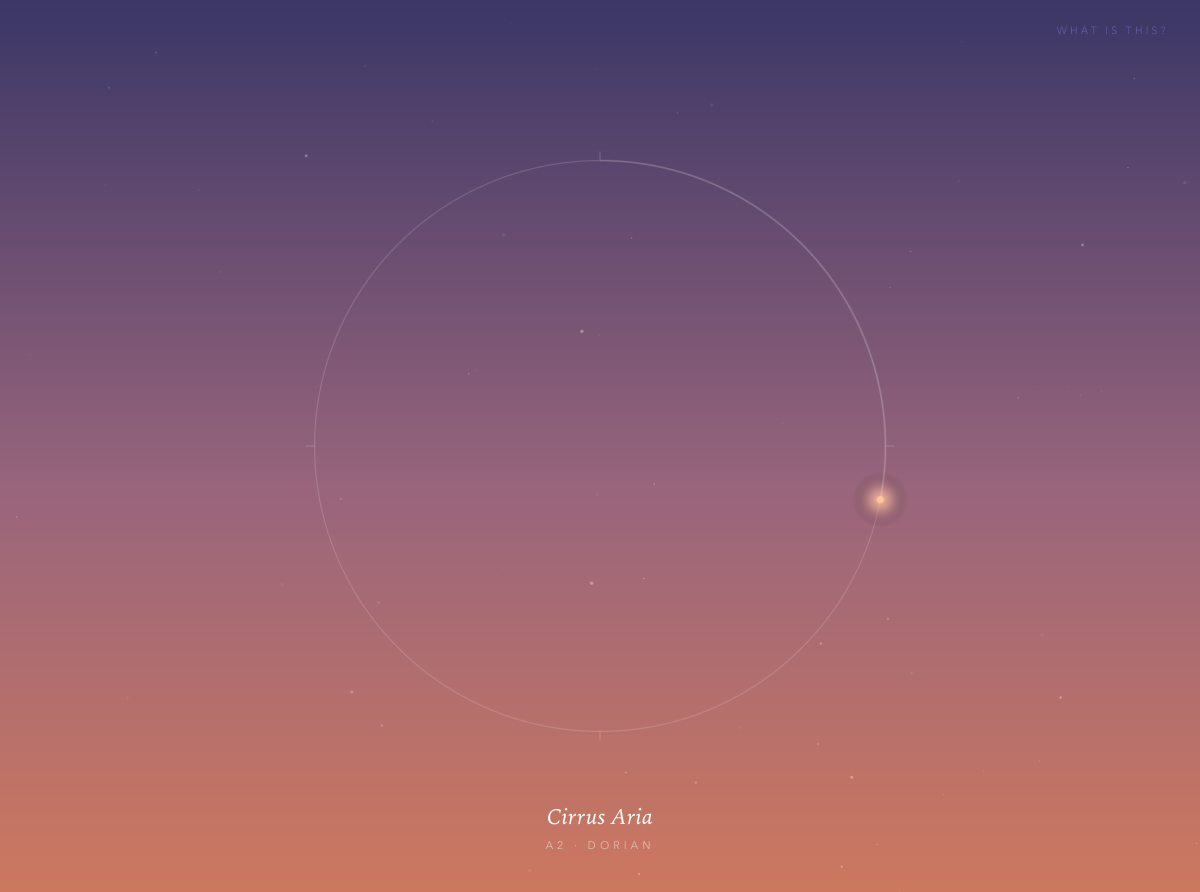
Diel
One generative chord that has been playing since the dawn of time. Open it and hear what time it is.
Comments
Comments are for signed-in players. It keeps the robots honest.
Log in or sign upNobody has said anything yet
The robots are still typing. Be the first human on the record.